The team
A small team building something that shouldn't exist yet — a scientific founder, a venture builder, and the clinician who runs the trials this program is designed to reach.
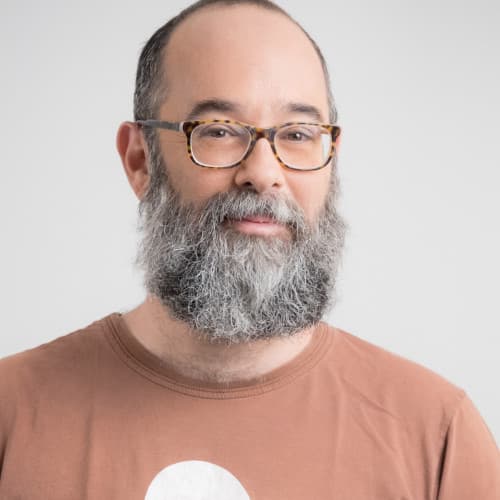
Tzvika Besor
I spent more than twenty years building and shipping software products — from 3D fashion tech to no-code platforms to cybersecurity — leading core products end to end, from concept and specification through development and production. The skills that carry across any domain — product definition, milestone planning, vendor and regulatory management, synthesizing dense technical literature — are the ones I lean on here.
For the last four years I've worked deeply with AI, building complex systems and research pipelines. When my wife was diagnosed with a Grade 3 IDH1-mutant astrocytoma — the exact cancer this program targets — I turned that capability on the problem.
Between March and July 2026 I developed the therapeutic concept using an AI-enriched research pipeline: large language models over graph databases organized around a biomedical ontology, coupled to protein-structure prediction (AlphaFold), genome-scale metabolic flux modeling, and automated, citation-backed synthesis of the IDH-mutant glioma literature. It let one person work across structural biology, enzyme biochemistry, thermodynamics, and clinical oncology at a depth and speed a traditional review can't match. That pipeline is what mapped the underlying biology and shaped the approach — including how the tumor's own metabolite could be used to target a therapy to the tumor, keep it contained there, and locally lift the immune brake where a response is ignited. The full computational dossier runs to fourteen analyses and fifty-plus pages.
I am not a biologist. I work with people who are. My job is to hold the vision, assemble the capability, and move the program faster than it would move without pressure.
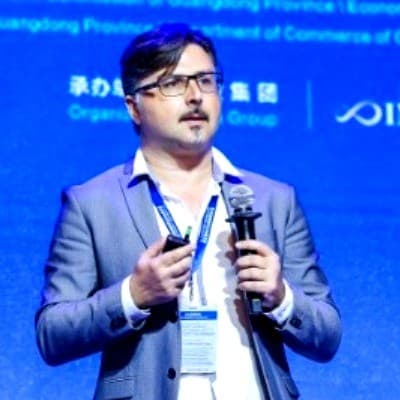
Roman Lasker
Roman is a serial founder and venture builder with more than two decades at the intersection of company creation, private capital, and innovation strategy. He has founded three companies — two acquired — and served as a partner across venture-capital and private-equity firms, building and scaling ventures from formation through exit. He is the author of A New Science of Venture Building, a framework for creating companies inside funds, corporations, and innovation ecosystems.
His prior companies include iCapital, an AI platform for financial institutions (acquired; selected for LSEG ELITE and the UK FCA Sandbox), and Uppspace, an AI reliability platform for mission-critical cloud infrastructure (acquired; four patents; winner of EY's The Journey). He holds an Executive MBA from the Kellogg School of Management (Northwestern) and a BA magna cum laude from Tel Aviv University, and is a member of YPO.
As Chairperson, Roman brings the venture-building and capital strategy that turn first-in-class science into a company — governance, fundraising, and the path from a funded research year to a durable organization.
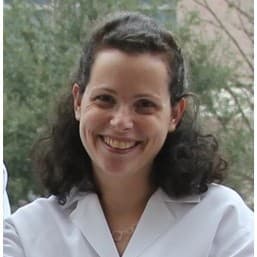
Dr. Shlomit Yust-Katz
Dr. Yust-Katz directs the Neuro-Oncology Unit at the Davidoff Center, Rabin Medical Center (Beilinson), and lectures at the Sackler School of Medicine, Tel Aviv University. She was a co-investigator on the pivotal INDIGO Phase III trial (Mellinghoff et al., NEJM 2023; Cloughesy et al., Lancet Oncology 2025) — the study that established vorasidenib as the first IDH-targeted therapy in glioma, and the clinical foundation this program builds on.
As the program's Clinical Principal Investigator, she brings the trial design, regulatory judgment, and patient-side perspective that carry laboratory findings toward first-in-human studies.
Scientific advisors and collaborators will be listed here as relationships are confirmed publicly.